
Market Commentary & Outlook Third Quarter 2026
Q3
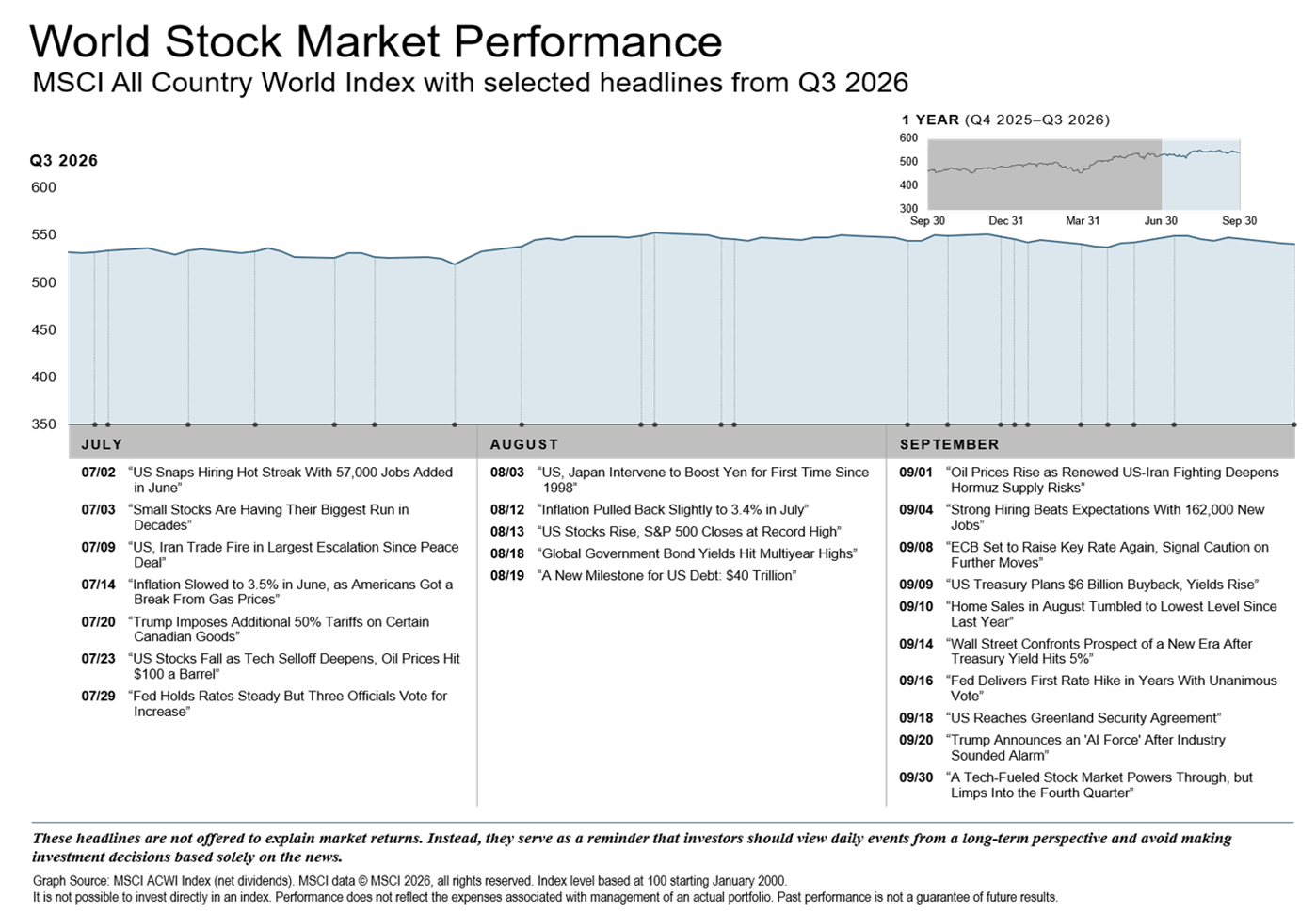
The third quarter of 2026 was defined by resilient economic growth, strong corporate earnings, elevated energy prices, and sharply rising bond yields. The U.S. Federal Reserve raised rates for the first time since 2023, despite efforts by the U.S. Treasury to support market liquidity through debt-buybacks and foreign exchange intervention. Equities continued to hold up, largely due to gains in large-cap technology and companies benefiting from continued investment in artificial intelligence.
Global Economy
Despite geopolitical uncertainty, global activity remained in expansion through Q3. While energy-related disruptions and supply chain pressures persisted, there was a broad-based improvement across global manufacturing activity. International markets posted modest gains, yet volatility was at a high as headwinds from sticky energy inflation, a Middle East supply shock, and a “higher-for-longer” reset on interest rates muted international performance relative to the first half of the year.
Developed International Markets (MSCI ACWI ex-U.S.) were up a modest .48% for quarter, yet remained up a healthy 10.81% for the year
Emerging Markets (MSCI EM) delivered a marginally negative return for the quarter, but remained positive 23.73% YTD
Korea and Taiwan suffered sharp mid-quarter corrections as a result of the AI semiconductor rally cooling
Energy was the standout performer – gaining 17.2% as oil surged
U.S. Economy
The U.S. demonstrated sturdy mid-cycle dynamics, with strengthening economic activity over the quarter. The manufacturing sector strengthened as PMIs (Purchasing Managers’ Indexes) rebounded. Leading indicators point to a strong underlying economy supported by an improving labor market and solid demand across corporate and consumer sectors.
Equity Markets
As Q4 begins, the S&P 500 Index is on track for a fourth year of double-digit positive returns, an achievement seen only three times in the last 100 years. The market was up 2.3% for the quarter and has risen 33% since the beginning of 2025. However, many of the gains were concentrated in large-cap technology with Artificial intelligence remaining one of the dominant investment themes of 2026.
Continued capital spending on AI infrastructure, semiconductors and related technologies supported many of the market's largest companies. However, the increasing concentration of market returns is something we believe investors should pay close attention to.
When a relatively small number of companies account for a disproportionate amount of an index's return, investors can become more exposed to valuation risk and concentration risk without necessarily realizing it.
This doesn't mean we believe investors should abandon technology. Quite the opposite - we continue to believe that AI and related technologies will have a significant impact on the economy and financial markets for years to come. But we believe there is an important distinction between participating in long-term technological innovation and allowing a portfolio to become unintentionally concentrated in a handful of companies.
Fixed Income
The most significant development of the quarter may have occurred outside of the stock market.
After several years of declining and historically low interest rates, Treasury yields moved sharply higher. The 10-year Treasury yield finished the quarter near 5.3%, a level not seen in roughly two decades. The Bloomberg U.S. Aggregate Bond Index declined approximately 3.5% during the quarter, while longer-duration Treasuries experienced an even more significant decline.
The move higher in yields was driven by several factors, including persistent inflation, higher energy prices, fiscal concerns and a Federal Reserve that became more focused on controlling inflation.
Commodities
The Bloomberg Commodity Total Return Index returned +16.19% for Q3. Gas Oil and Heating Oil were the top performers by a landslide, returning +76.86% and +59.98% respectively while Natural Gas lagged at -13.60%. Commodities were up 16.19% for Q3 and 32.87% YTD.
Looking Forward
As we enter the fourth quarter, the investment environment remains complicated.
Economic growth has remained resilient, corporate earnings have provided support for equities, and the long-term opportunity surrounding AI remains significant. At the same time, inflation remains above the Federal Reserve's target, Treasury yields are considerably higher, and geopolitical developments have added uncertainty to the energy and economic outlook.
We don't believe the appropriate response to this environment is to make dramatic changes based on short-term market movements. Instead, we continue to focus on what we can control: maintaining appropriate diversification, managing risk, identifying attractive long-term opportunities and being intentional about the tax consequences of investment decisions.
Why Diversification Still Matters
The third quarter provided another good example of why we believe diversification should extend beyond simply owning more stocks.
Different areas of the market performed very differently. Energy was among the strongest areas of the market, while utilities, small-cap stocks and other rate-sensitive investments struggled. International markets also provided a different return profile than U.S. large-cap technology.
Within our portfolios, we continue to look for opportunities across traditional equities and fixed income, as well as private credit, private equity, alternative strategies and tax-managed investments.
Our objective isn't to predict which asset class will outperform next quarter. Instead, we want to build portfolios that can participate in growth while maintaining multiple sources of return and managing the risks associated with any single market environment.
Tax Management Remains a Major Focus
For many of our clients, particularly those with substantial taxable portfolios, investment management cannot be separated from tax management.
We continue to place significant emphasis on tax-loss harvesting, direct indexing, tax-aware investment strategies and thoughtful management of realized gains. In an environment where certain areas of the market have appreciated substantially, managing the tax consequences of portfolio changes can be just as important as determining what to buy or sell.
We also continue to evaluate opportunities in private investments and alternative strategies where we believe they can provide meaningful diversification, income or tax benefits.
As always, our goal is not simply to maximize returns in any individual quarter. It is to build and manage portfolios that help our clients achieve their long-term financial objectives while being thoughtful about risk, taxes and the opportunities available in an increasingly complex investment landscape.
Thank you for your continued trust in Paradigm Wealth Management.
References: Morningstar, DFA, BlackRock and Fidelity