

Market Commentary & Outlook Second Quarter 2026
Q2
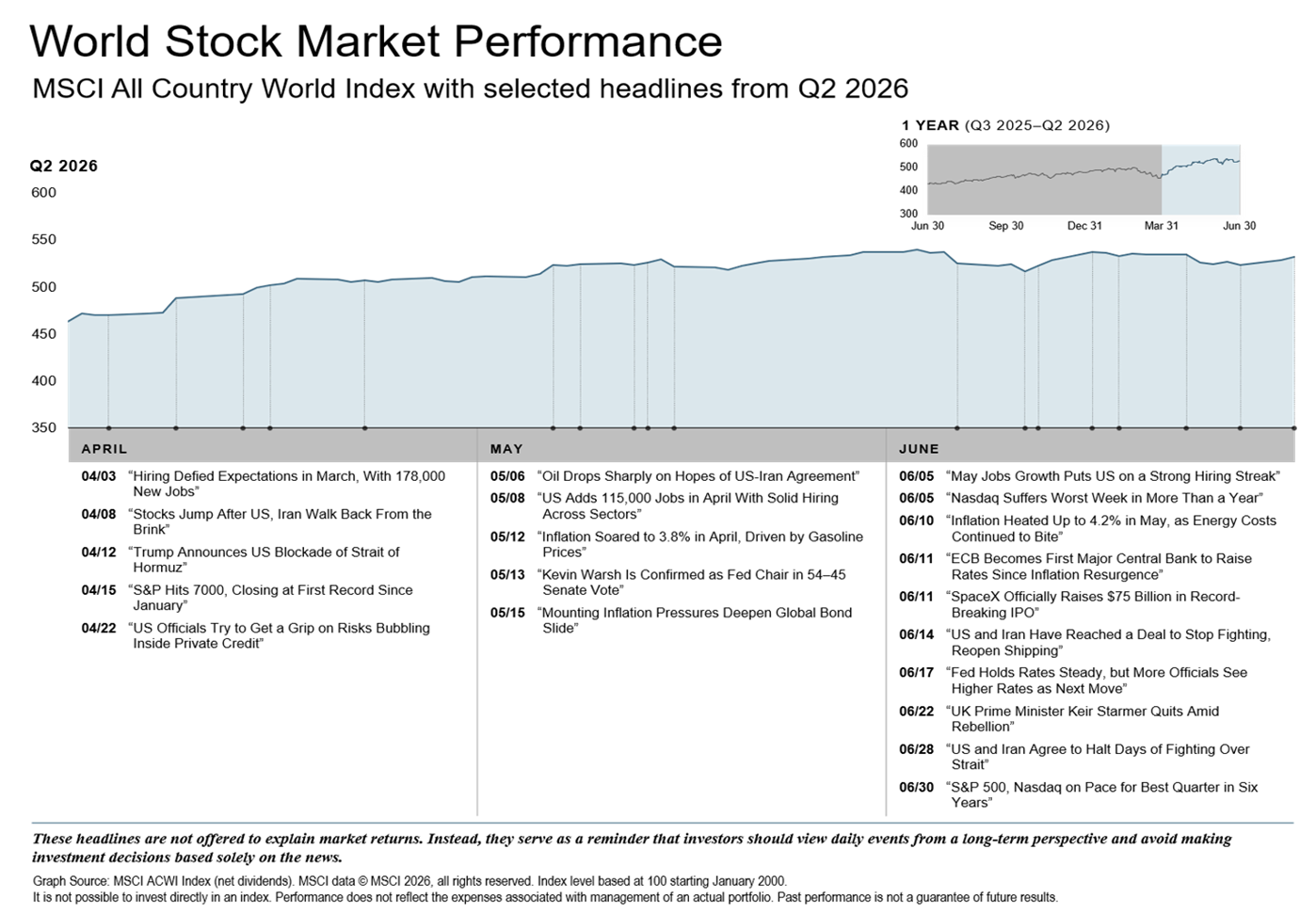
As you reflect on the second quarter of 2026, it bears repeating that long-term orientation remains our strongest asset. Q2’s markets balanced optimism about continued economic growth with periodic bouts of volatility. This is a prime example of why it is foundational to highlight how quickly the narrative can change - a reminder that market commentary is often much less stable than solid investment principles.
Recent headlines often focused on short-term uncertainty, yet the broader economic backdrop remained constructive. Businesses continued to adapt to changing conditions, consumers remained resilient, and inflation showed further signs of moderating.
The conflict involving Iran remained a significant focus for investors throughout the quarter. Concerns surrounding the possibility of sustained disruptions to the global energy supplies, higher inflation, and slower economic growth dominated headlines early on in Q2, but as the quarter progressed, markets reflected easing tensions.
Read on as we go into more detail!
Global Economy
The second quarter of 2026 was characterized by resilient, but uneven, global economic growth. Inflation continued to moderate across many developed economies, allowing several central banks to either pause or begin gradually easing monetary policy. While lower inflation supported consumer spending and business confidence, growth remained constrained by geopolitical uncertainty, evolving trade relationships, and regional differences in economic performance.
The United States continued to outperform many developed markets, supported by healthy labor markets and resilient consumer demand. Europe experienced modest growth as lower energy prices and improving manufacturing activity offset persistent structural challenges. In Asia, economic performance was mixed, with India maintaining strong momentum while China's recovery remained uneven amid continued weakness in the property sector and subdued consumer confidence.
Corporate earnings generally exceeded expectations globally, reflecting companies' ability to manage costs and maintain profitability despite slower revenue growth. Although geopolitical risks remained elevated, financial markets demonstrated resilience throughout the quarter.
Developed markets outside U.S. underperformed both U.S. and emerging markets
Emerging Markets, Korea and Taiwan, benefited from strong demand in AI supply chain
Growth posted best returns (+13.50%)
Small caps (+7.94%) underperformed large caps (+11.08%)
U.S. Economy
The U.S. economy remained on solid footing during the second quarter. Consumer spending continued to support economic activity, aided by steady wage growth and historically low unemployment. While economic growth moderated from the robust pace experienced in prior years, it remained consistent with a healthy expansion.
Inflation continued its gradual decline toward the Federal Reserve's long-term objective, although progress was uneven across various sectors. Housing activity showed signs of stabilization as mortgage rates leveled off, while business investment remained constructive, particularly in technology, artificial intelligence infrastructure, and industrial manufacturing.
The Federal Reserve maintained a cautious, data-dependent approach, balancing continued progress on inflation with the need to preserve economic growth. Markets increasingly anticipated a gradual easing cycle later in the year, though policymakers emphasized that future decisions would remain dependent on incoming economic data.
Equity Markets
Equity markets produced positive returns during the second quarter, though leadership broadened beyond the handful of mega-cap technology companies that dominated performance in recent years.
Large-cap U.S. stocks continued to benefit from strong corporate earnings and continued investment in artificial intelligence and digital infrastructure. Small- and mid-cap companies also participated more meaningfully as expectations for lower interest rates improved investor sentiment.
International developed markets posted modest gains, supported by improving economic conditions and a weaker U.S. dollar. Emerging markets delivered mixed results, reflecting divergent economic conditions across regions.
While market valuations remain above historical averages in certain sectors, earnings growth continues to provide an important foundation for equity prices. Investors should expect periodic volatility as markets adjust to evolving monetary policy and geopolitical developments.
U.S. Stock Market (+15.44%)
Small caps outperformed large caps
Value underperformed growth
Fixed Income
Fixed income markets experienced a constructive quarter as Treasury yields generally stabilized and bond prices benefited from improving inflation expectations.
High-quality investment-grade bonds generated attractive total returns while continuing to provide meaningful income opportunities not seen in many years. Municipal bonds remained attractive for taxable investors seeking tax-efficient income, while corporate credit fundamentals stayed healthy despite modest spread fluctuations.
The bond market continues to offer improved diversification benefits within balanced portfolios after several years of elevated interest rate volatility. Maintaining diversified duration exposure remains appropriate given uncertainty surrounding the timing and magnitude of future Federal Reserve policy actions.
Within U.S. Treasury Market, interest rates generally increased during quarter
Yield on 2-Year Treasury Note increased 35 bps to 4.14%
Yield on 5-Year Treasury Note increased 27 bps to 4.19%
Commodities
Commodity markets experienced mixed performance during the quarter.
Energy prices remained volatile due to geopolitical developments and shifting global supply dynamics, while industrial metals benefited from continued investment in infrastructure, electrification, and artificial intelligence-related capital expenditures. Gold maintained relatively elevated levels as investors balanced moderating inflation with ongoing geopolitical uncertainty and central bank purchases.
Agricultural commodities experienced normal seasonal fluctuations, with weather patterns continuing to influence production expectations.
Overall, commodities continued to serve as an important portfolio diversifier amid persistent macroeconomic uncertainty.
The Bloomberg Commodity Total Return Index returned -8.08%
Silver (-20.45%) and Crude Oil (-19.12%) were worst performers
Cocoa (+48.32%) and Zinc (+10.95%) were the best performers
Looking Forward
As we enter the second half of 2026, investors continue to navigate an environment marked by moderating inflation, resilient economic growth, and evolving monetary policy. While risks remain, including geopolitical developments, fiscal policy uncertainty, and potential market volatility, the fundamental backdrop remains generally supportive for long-term investors.
Corporate earnings, healthy consumer balance sheets, and continued innovation across sectors such as artificial intelligence, healthcare, and advanced manufacturing provide reasons for optimism. At the same time, elevated market valuations and changing interest rate expectations reinforce the importance of maintaining diversified portfolios aligned with long-term financial objectives.
Rather than attempting to anticipate short-term market movements, we believe successful investing continues to be grounded in disciplined asset allocation, broad diversification, and a focus on long-term goals. Market volatility is a normal part of investing and often creates opportunities for patient investors.
At Paradigm Wealth Management, our investment philosophy is rooted in disciplined portfolio management and thoughtful financial planning. We believe that successful investing is achieved not by predicting every market fluctuation, but by building diversified portfolios designed to help clients achieve their long-term financial goals through a variety of market environments. We appreciate the trust our clients place in us and remain dedicated to providing thoughtful guidance through every market environment.
The Paradigm Wealth Management Team

References: Morningstar, LPL Financial, Bloomberg, and JP Morgan